Why the intraoral approach is the standard
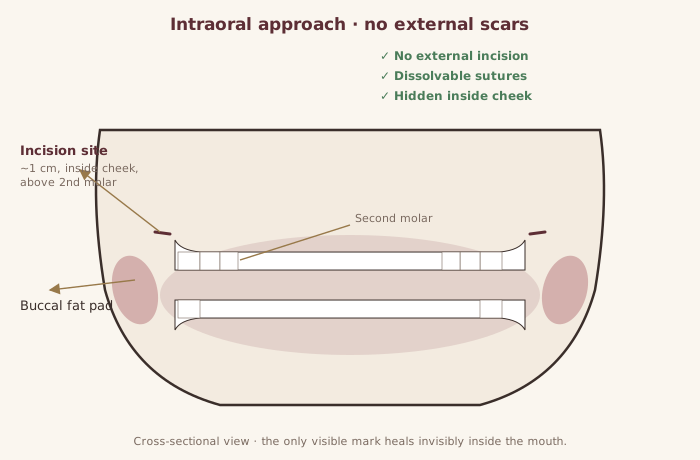
The buccal fat pad sits between the buccinator muscle (the inner cheek muscle) and the masseter muscle. From outside the cheek, accessing it would require cutting through the full thickness of the cheek — leaving a visible external scar, and creating an unacceptable risk of damaging facial nerve branches and the parotid duct.
From inside the mouth, the path is much shorter and the major nerves and blood vessels are anatomically out of the way. The buccinator muscle is thin and easily separated, and the encapsulated fat pad presents itself for removal once the muscle is opened.
Step-by-step technique
- Anaesthesia. Local anaesthesia with intravenous sedation is sufficient for most patients. The intraoral region is generously infiltrated with local anaesthetic to provide both anaesthesia and vasoconstriction (reducing bleeding).
- Marking. The expected location of the fat pad is identified externally — it sits over the body of the masseter, between the zygomatic arch (cheekbone) and the lower border of the mandible.
- Incision. A horizontal incision of approximately 1 cm is made on the inside of the cheek, above the second upper molar tooth. This location is chosen because: (a) it is the most direct path to the body of the fat pad, (b) it avoids the parotid duct opening which sits forward of it, and (c) it leaves no visible internal scar.
- Dissection. The buccinator muscle is gently separated, exposing the encapsulated buccal fat pad. The capsule has a characteristic yellow-pearl colour that distinguishes it from the surrounding tissues.
- Delivery. Gentle external pressure on the cheek encourages the fat to herniate into the wound — it is not aggressively pulled or "dug out". This is the key technical point that distinguishes a controlled, conservative resection from over-resection.
- Resection. The planned volume is excised — typically 2–3 grams per side in Dr. Erdal's standard practice. The fat is removed with cautery to maintain haemostasis.
- Closure. Two or three dissolvable sutures close the intraoral incision. The procedure is repeated on the other side. Total operating time: 30–45 minutes for the entire procedure.
Anaesthesia choice
Three options:
- Local anaesthesia alone — uncommon, only for short single-side resections; not preferred.
- Local anaesthesia with intravenous sedation — Dr. Erdal's usual choice. The patient is relaxed and unaware but not fully unconscious. Faster recovery, lower cost.
- General anaesthesia — for anxious patients, those with significant gag reflex, and for combined procedures (e.g. with rhinoplasty).
Why not 'minimal' or 'no-incision' techniques?
You will see some clinics market "minimal-incision" or "scarless" buccal fat removal. The reality:
- The standard intraoral incision is already only ~1 cm long, hidden inside the mouth where it cannot be seen, and heals to invisibility within 1–2 weeks. There is no aesthetic benefit to making it shorter.
- Smaller incisions actually increase the risk of complications because visualisation of the dissection field is compromised. Trying to remove a 3-gram piece of fat through a 5 mm incision is harder than through a 10 mm incision.
- Some clinics use the language as a marketing differentiator rather than a meaningful technical advance.
The standard intraoral incision is the right size. There is no scar problem to solve.
Frequently asked questions
Where exactly is the incision?
About 1 cm long, on the inside of the cheek, just above the second upper molar tooth. It is completely invisible from outside the mouth and heals to be invisible inside the mouth within 1–2 weeks.
Does the incision affect speaking or eating?
Speaking is unaffected from day 1. Eating is restricted to soft foods for 3–5 days while the incision heals. After that, normal diet.
Are stitches removed?
No — the sutures used are dissolvable. They typically fall away in the mouth at 7–14 days. No suture removal appointment needed.
Not sure if you're a candidate?
Buccal fat pad removal is the right choice only for the right face. Send 3 facial photos (front, profile, three-quarter) and Doç. Dr. Erdal will give you an honest, no-pressure suitability assessment before you decide anything.
Ready to discuss buccal fat removal?
Schedule a free WhatsApp consultation with Doç. Dr. Erdal. Send a few facial photos and your questions — typical response within 2 hours during business hours.