What the buccal fat pad actually does
The buccal fat pad is not ordinary subcutaneous fat. It is a discrete, encapsulated mass of specialised adipose tissue in the mid-cheek, with a clearly defined body and several extensions. Its biological purpose is to provide a low-friction gliding plane between the muscles of mastication — when you chew, the buccal fat pad allows those muscles to move past each other smoothly. It also occupies space that, if removed, leaves a permanent contour change.
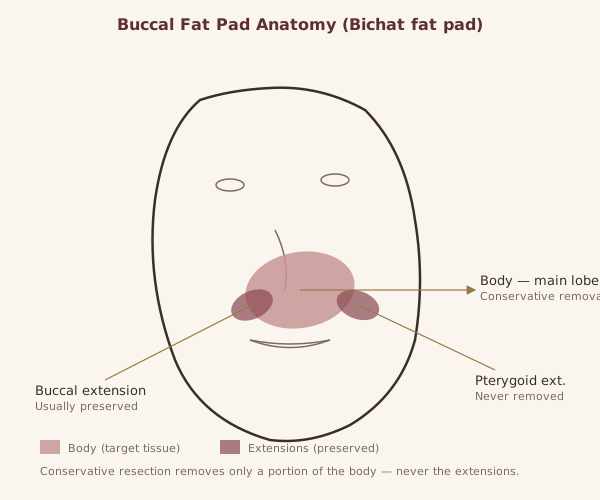
The three extensions — and why they are usually preserved
The buccal fat pad has a central body and three thinner extensions: the buccal extension (forward, toward the corner of the mouth), the pterygoid extension (backward, toward the angle of the jaw), and the temporal extension (upward). Only the body is typically targeted in aesthetic buccal fat removal. The extensions perform important structural and functional roles and removing them carries unjustifiable risk for negligible aesthetic gain.
The surgical technique step by step
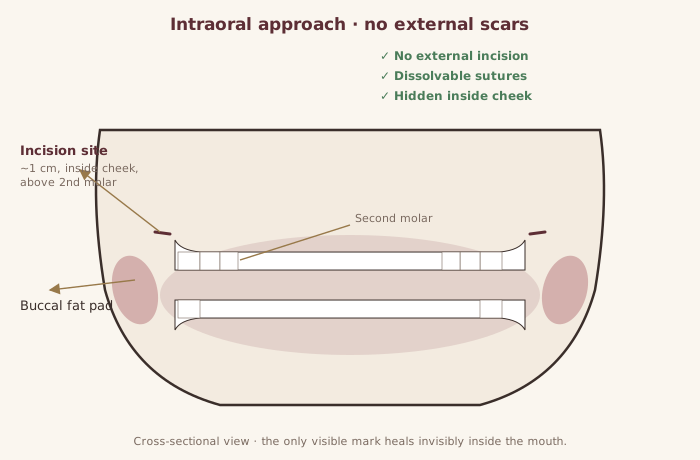
- Anaesthesia. Local anaesthesia with intravenous sedation is sufficient for most patients. Full general anaesthesia is offered for anxious patients or combined procedures.
- Marking. The buccal fat pad's expected position is marked externally on the cheek — typically over the body of the masseter, just below and slightly forward of the cheekbone.
- Incision. A small horizontal incision (~1 cm) is made on the inside of the cheek, above the second upper molar. This location is chosen because it gives the most direct access to the body of the pad while avoiding the parotid duct.
- Dissection. The surgeon dissects through the buccinator muscle until the encapsulated buccal fat pad becomes visible. Gentle pressure on the outside of the cheek encourages the pad to deliver itself into the wound — it does not need to be 'dug out'.
- Resection. The volume removed is planned in advance, typically a partial resection that preserves the deeper portions and all three extensions. The fat is removed with cautery to control bleeding.
- Closure. The intraoral incision is closed with dissolving sutures. The procedure is repeated on the other side. Total operating time: 30–45 minutes.
How much fat is removed?
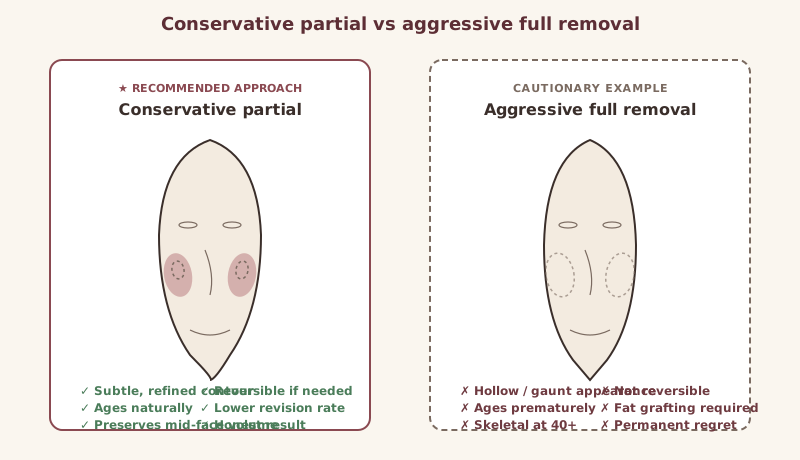
This is the most important decision in the entire operation. The body of an adult buccal fat pad typically weighs 9–10 grams in total. Aesthetic removal volumes range from 1 to 5 grams per side. A removal of 1–2 grams per side produces a subtle but lasting refinement; 3–4 grams is aggressive; 5+ grams predictably produces a hollow appearance that becomes more pronounced with age.
Dr. Erdal's standard practice is conservative partial removal — typically 2–3 grams per side in a well-selected candidate. This produces a refined, natural-looking contour that ages well, rather than the sharp, "snatched" look that flatters a 25-year-old but ages a 40-year-old by ten years.
Who is a good candidate — and who is not
Buccal fat pad removal is one of the procedures where suitability matters more than technique. The ideal candidate is:
- In their 20s or early 30s
- Has a naturally round or fuller mid-face with prominent cheek pads
- Has good skin elasticity
- Is at or near a stable, healthy weight
- Understands the result is permanent and is comfortable with that
Conversely, a poor candidate is anyone with:
- An already thin or narrow face
- Visible age-related volume loss (hollow temples, flat cheekbones)
- Long, oval, or rectangular face shape
- Unrealistic expectations driven by celebrity photos or "before/after" videos that exaggerate the effect
- A history of significant weight loss without weight stabilisation
Dr. Erdal turns away approximately one in four buccal fat removal inquiries on the basis of unsuitability. Read the full suitability guide →
Recovery in summary
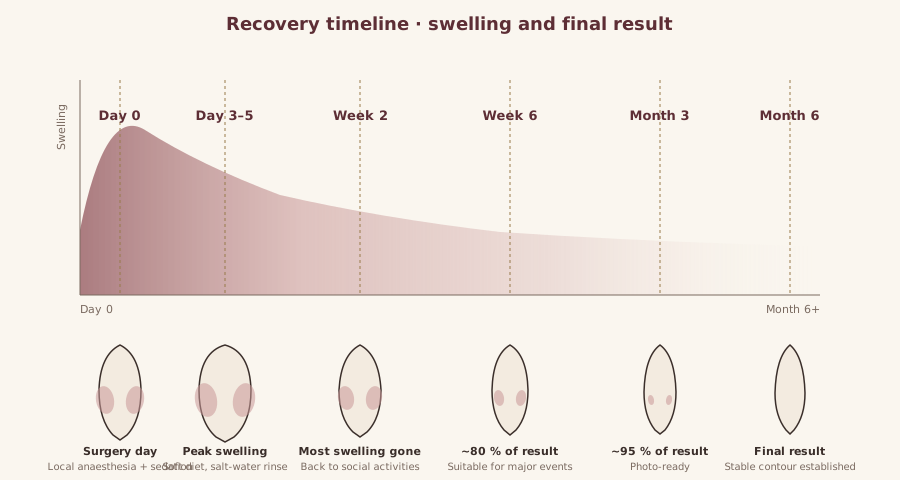
- Day 0: Surgery, same-day discharge
- Day 1–3: Soft diet, salt-water rinses, ice intermittently. Most pain controllable with paracetamol.
- Day 3–5: Swelling peaks. The cheeks may look fuller than before surgery — this is expected and temporary.
- Day 7–10: Return to work for most patients. Visible swelling reducing markedly.
- Week 2: Most swelling resolved; back to social activities and gentle exercise.
- Week 6: ~80% of the final result visible.
- Month 3: ~95% of the final result; suitable for photos and major events.
- Month 6: Final stable contour established.
Risks and realistic limitations
Like any surgical procedure, buccal fat pad removal has risks. With a careful technique by an experienced surgeon, serious complications are uncommon — but they are not zero.
- Asymmetry. The two sides of the face are never perfectly symmetric to begin with, and small asymmetries can be magnified by surgery. Minor differences are common; significant asymmetry requiring revision is rare.
- Over-resection. Removing too much fat produces a hollow, gaunt appearance that becomes more pronounced with age. Once fat is removed, it cannot be put back in its native anatomical form — only partial volume restoration via fat grafting is possible.
- Damage to nearby structures. The parotid duct (which carries saliva) and small branches of the facial nerve are close to the surgical field. Injury is rare with proper anatomical knowledge.
- Infection. The mouth is bacterially rich, but post-operative salt-water rinses and short antibiotic course keep infection rates very low.
- Long-term aesthetic regret. Trends in facial aesthetics change. The 'snatched' look is currently fashionable; in 15 years it may not be. A conservative result ages better than an aggressive one regardless of fashion.
Frequently asked questions
What exactly is the buccal fat pad?
The buccal fat pad (also called the Bichat fat pad after the French anatomist Marie François Xavier Bichat) is a discrete encapsulated mass of specialised fat located in the mid-cheek. It has a main body and three smaller extensions (buccal, pterygoid, and temporal). It is separate from the subcutaneous fat that gives the cheek its general fullness.
Is buccal fat removal the same as bichectomy?
Yes — bichectomy and buccal fat pad removal refer to the same procedure. 'Bichectomy' is the more aesthetic-marketing term used in Latin America and increasingly elsewhere; 'buccal fat pad removal' or 'buccal lipectomy' is the medical term.
How is the surgery performed?
Through a small incision (~1 cm) inside the cheek above the second upper molar, the buccal fat pad is identified and a conservative volume is gently teased out. Closure is with dissolvable sutures. The procedure typically takes 30–45 minutes under local anaesthesia with sedation or general anaesthesia.
How long is the recovery?
Visible swelling resolves over 2–3 weeks; most patients return to work in 5–7 days. The final, settled contour appears at 3–6 months once swelling has fully resolved and the surrounding tissues have adapted.
Is the result permanent?
Yes — the removed buccal fat does not grow back. However, the broader cheek continues to age normally, and natural age-related fat loss may continue to slim the face over decades.
Can I look gaunt later in life?
It is a real concern, particularly for patients who are not ideal candidates to begin with — thinner faces, older patients, or those undergoing aggressive 'maximum' resection. Conservative partial removal in a well-selected candidate carries much lower risk of this outcome. This is the single most important reason patient selection cannot be skipped.
What are the main risks?
Major risks are bleeding, infection, asymmetry, damage to the parotid duct or facial nerve branches, and over-resection (which cannot be reversed). With experienced surgeons using a conservative technique and proper anatomical knowledge, these are uncommon, but not zero.
Will my buccal fat removal show on the outside?
There are no external incisions or scars — the entire procedure is performed inside the mouth. During the first 1–3 weeks the cheeks will be swollen, but once swelling resolves there is nothing to see except the change in contour.
Not sure if you're a candidate?
Buccal fat pad removal is the right choice only for the right face. Send 3 facial photos (front, profile, three-quarter) and Doç. Dr. Erdal will give you an honest, no-pressure suitability assessment before you decide anything.
Ready to discuss buccal fat removal?
Schedule a free WhatsApp consultation with Doç. Dr. Erdal. Send a few facial photos and your questions — typical response within 2 hours during business hours.